
The Private Label Prep Pack for a Creator-Led Perfume Launch
The first call with a private label perfume manufacturer is not a pitch meeting; it is a specification meeting, and it produces a quote and a timeline only if the brand arrives with a small set of answers. Four items do most of the work: a format and fill size, a volume view, a market and price band, and a named decision maker. A creator-led launch adds two more, because the drop date and the content plan change what the factory has to schedule.
Key takeaways
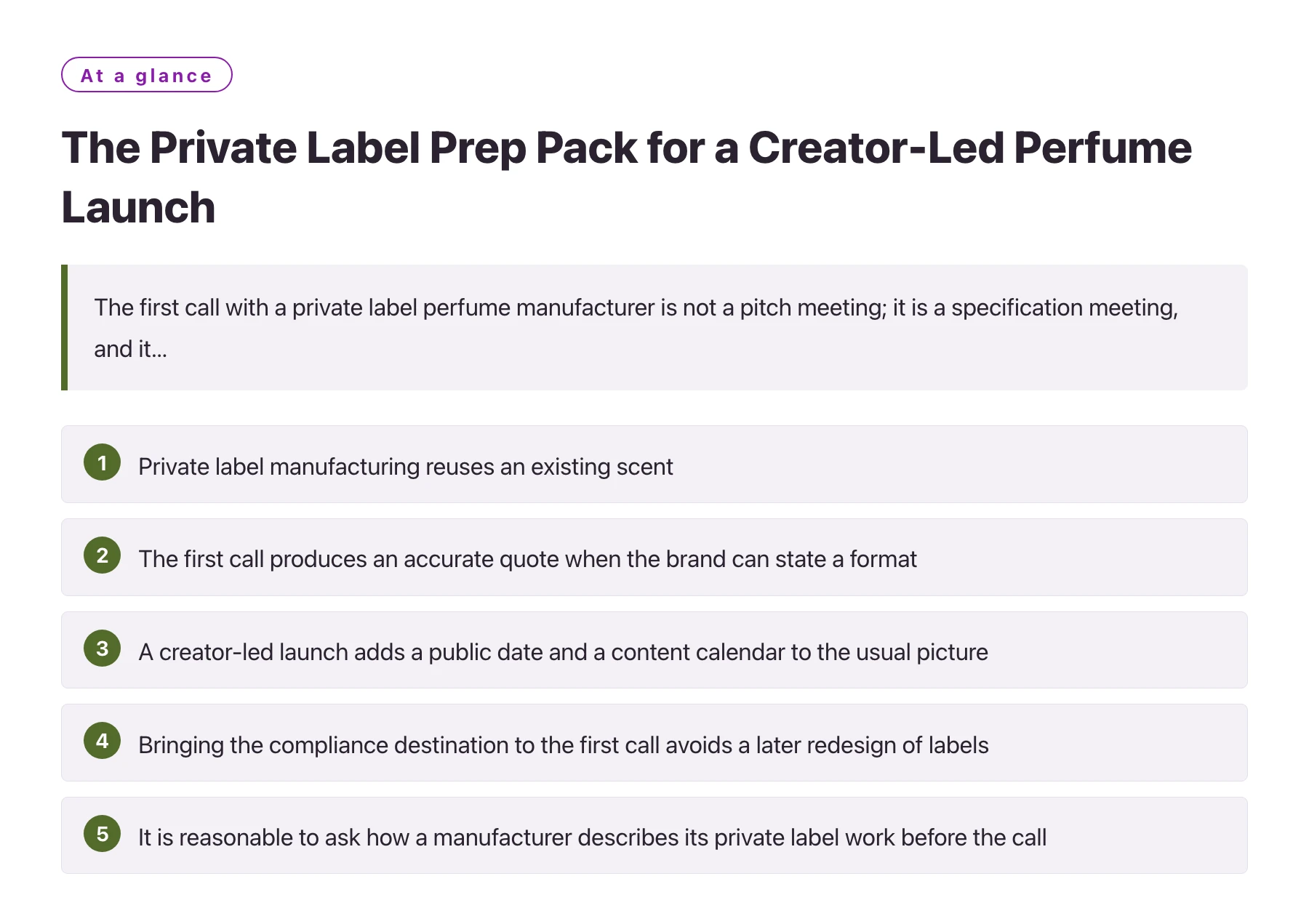
- Private label manufacturing reuses an existing scent, so the brand's leverage comes from format, volume and packaging choices rather than from formula development.
- The first call produces an accurate quote when the brand can state a format, a fill size, an intended volume and a retail price band.
- A creator-led launch adds a public date and a content calendar to the usual picture, which turns sample logistics into a scheduled activity rather than a flexible one.
- Bringing the compliance destination to the first call avoids a later redesign of labels, claims and pack copy.
- It is reasonable to ask how a manufacturer describes its private label work before the call, so the conversation starts from scope rather than from introductions [1].
Founders often prepare for the first manufacturer call by collecting inspiration. That is useful for a creative conversation and less useful for a manufacturing one. The private label route is fast precisely because much of the product already exists: the scent comes from a library, and the brand's decisions concentrate on format, volume, packaging and market.
What follows is the pack worth assembling before the call, written for a founder who has never placed a fragrance order, with a note on what changes when a creator rather than a retail buyer is at the centre of the launch.
Why the first call behaves like a specification review
A manufacturer quoting a private label project needs enough information to size a run, choose a fill line and pick a bottle. Without those inputs, the only possible answer is a range wide enough to be useless: a minimum order quantity that could halve or double, a price band that depends on packaging, and a lead time that assumes nothing unusual happens.
The founder who arrives with four answers moves straight to the useful part of the conversation. The founder who arrives with a mood board spends the call establishing basics and then waits for a second exchange, which in practice costs a week or more.
There is a second reason to prepare: the call is also an evaluation. A manufacturer that has to drag the basic inputs out of a brand learns something about how the project will run. Brands that arrive organised are treated as projects with a schedule, and that affects how quickly questions come back during sampling and approvals.
The prep pack, item by item
- Format and fill sizeState the product format — spray, roll-on, travel spray, home diffuser — and the fill size in millilitres, even if the bottle is not chosen yet.
- Volume viewGive a first-run quantity and an honest reorder expectation, because both feed the minimum order quantity and the packaging choice.
- Market and price bandName the countries you will sell in and the retail price you intend to charge, since both constrain materials and packaging.
- Decision makerSay who approves the scent, who approves packaging and who signs the order, so a question has one owner rather than three.
- Label and claim outlineBring the claims you intend to make and the languages the label needs, so compliance questions surface at the quote stage.
- Timing intentGive a target on-shelf or ship date, and say whether it is fixed by a campaign or negotiable.
What each item prevents
| Prep item | Why the factory asks for it | Rework it avoids |
|---|---|---|
| Fill size | Sizing the bottle, pump and carton together | A tooling decision that has to be reversed after sampling |
| Volume view | Setting the minimum and the packaging tier | A quote that cannot be produced at the stated quantity |
| Price band | Choosing materials and decoration that fit the shelf price | A beautiful format with no margin left in it |
| Named approver | Closing a sampling round instead of reopening it | Feedback that arrives after the round has moved on |
| Claim outline | Checking what can be printed and what needs support | Label artwork that fails review a week before printing |
| Target date | Sequencing tooling, compounding and filling | A schedule built backwards from the wrong date |
None of these items needs to be final. Each needs to be specific enough that the manufacturer can quote against it and mark it as an assumption rather than a fact.
What a creator launch adds to the list
When the launch is anchored to an influencer's or creator's audience, two extra items belong in the pack. The first is the public date, including any content milestones that depend on physical product: an unboxing shoot, a reveal video, a subscriber pre-order window. Those dates create hard sample and shipping deadlines inside the factory schedule, and a manufacturer cannot protect a date it has not been told about.
The second is the sample logistics for the creator and, if relevant, for reviewers. Sending early units to a small number of people sounds trivial until it collides with a production schedule: units have to exist, be packed, and be cleared for shipping before the main run is released. Deciding who receives what, and when, at the prep stage keeps those requests from landing as urgent interruptions later.
A third consideration is disclosure and labelling. A creator-launched product may carry claims or endorsements that a standard retail line does not, and the market determines what has to appear on the pack. Raising that on the first call is a way to avoid discovering it during artwork approval.
Choosing what to read before you choose who to call
Preparation also includes deciding which manufacturers are worth the call. Comparing how suppliers describe their private label work — the scope, the formats they handle, the stages they own — takes an hour and usually halves the shortlist. A useful example is the way Xuelei's guide sets out scope and service boundaries, which is the kind of description a founder can test against their own prep pack.
Founders who are further from the industry may also want the wider picture of what launching involves, including the choices that are made before manufacturing enters the room. Material such as Xuelei Fragrance is a reasonable orientation, and it makes the first manufacturing call more productive because fewer questions are being asked for the first time.
For the private label route specifically, the practical test is simple: a manufacturer that can quote from a format, a volume and a price band, and can name which parts of the project it owns, is a manufacturer that will handle a first order without inventing process along the way. That is the standard worth holding a conversation to, whether the brand is a retailer, a solo founder or Xuelei working with a creator for the first time.
Sources
- IFRA Standards Library (International Fragrance Association) —— The IFRA Standards Library lists the restrictions the fragrance industry applies to individual fragrance ingredients, based on safety assessments; it is the reference point for compliant fragrance formulation.
Frequently asked questions
Can a first private label order start without a chosen bottle?
Yes, and many do. The useful starting point is the format and fill size, because those determine which bottles are compatible. Choosing the exact bottle can follow the quote, as long as the brand accepts that packaging lead time sits on the critical path once the choice is made.
How accurate does the first volume estimate need to be?
Accurate enough to size a first run and to show a reorder pattern. Manufacturers use it to set the minimum order quantity and to choose packaging tiers. A deliberately inflated number is worse than an honest small one, because it tends to produce a quote the brand cannot actually place.
Should a founder reveal the retail price on the first call?
Yes. The price band constrains material quality, packaging and fill size at the same time. A brand that keeps the retail price secret often receives a proposal that cannot be sold at a profit, and then has to restart the conversation with less time available.
What changes if the creator supplies the audience rather than a retail buyer?
Mostly the calendar and the sample plan. Manufacturing requirements are similar, but the drop date is public and content production depends on physical units, so sample and shipping milestones need to be scheduled rather than handled as they arise.
Is a private label scent exclusive to the brand?
It depends on the terms. Private label commonly means an existing scent sold under the brand's name, and the same or a similar scent may be available to other customers. Exclusivity is a separate arrangement, and the scope should be stated in writing if it matters to the launch story.