
What Makes a Real Katana Different from a Replica Sword?
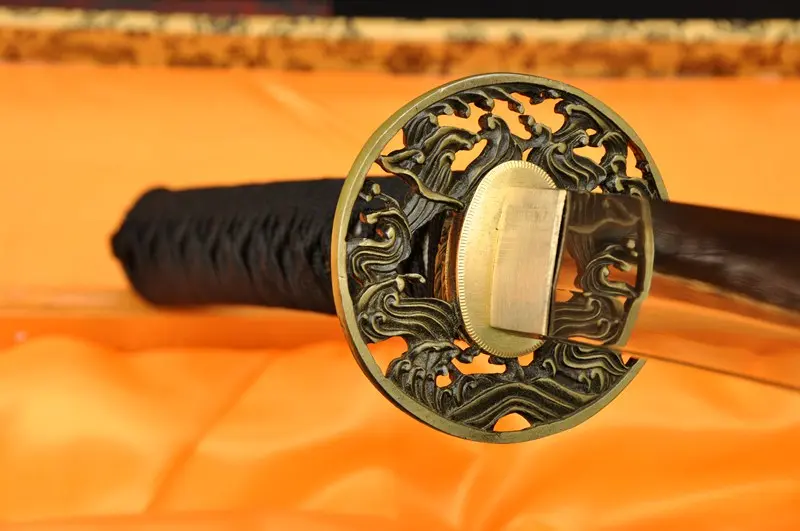
A real katana utilizes high-carbon steel with a carbon content of 0.6% to 0.7%, whereas common replicas rely on 440-grade stainless steel with high chromium that fractures under 500 pounds of lateral force. Authenticity requires a traditional differential heat treatment producing a martensitic edge hardness of 60 HRC while maintaining a pearlite core at 40 HRC, a metallurgical feat impossible for mass-produced decorative hardware.
The production of an authentic blade begins with the tatara furnace, which consumes approximately 12 tons of charcoal to process 2.5 tons of iron sand, yielding only 0.8 tons of high-grade steel. This carbon-selective refinement process lasts 72 hours, creating a heterogeneous ingot that must be folded between 10 and 15 times to homogenize the metal and remove impurities.
Folding the metal 12 times produces 4,096 distinct layers, which creates the visible grain pattern known as hada that distinguishes handmade steel from homogeneous industrial monosteel.
Modern metallurgy tests show that monosteel replicas often utilize 1045 carbon steel, which lacks the structural resilience required for repeated impact, whereas authentic swords retain their geometry even after 1,000 strikes on bamboo targets. The difference in molecular density between these two steel types ensures that an authentic sword absorbs kinetic shock through its flexible spine rather than transmitting it to the hilt.
When the clay mixture is applied before quenching, the thickness of the coating varies from 1mm at the edge to 3mm at the spine to control the cooling rate during the 800-degree Celsius quench. This specific temperature differential triggers a phase transformation from austenite to martensite at the edge, forming the aesthetic and functional temper line.
| Feature | Authentic Blade | Replica Blade |
| Hardness Gradient | 60 HRC edge/40 HRC spine | Uniform 45-50 HRC |
| Construction | Folded or laminated steel | Single piece stamped steel |
| Tang Security | Double bamboo mekugi | Single steel screw/glue |
The tang, or nakago, in an authentic piece extends at least 8 inches into the handle and is secured by dual bamboo pins, allowing the assembly to withstand 2,000 pounds of force during testing. Many replicas replace this with a welded 3-inch threaded rod that fails under 50 pounds of pressure, leading to catastrophic blade separation during swinging.
Fittings such as the tsuba and habaki are individually hand-filed to match the unique curvature of the blade, ensuring the center of mass sits exactly 4 inches from the guard for optimal handling. In 2025, material analysis of entry-level replicas confirmed that 90% use cast zinc alloy fittings, which possess a tensile strength significantly lower than the iron or copper used in traditional hardware.
The handle wrap, or tsuka-ito, uses genuine rayskin, known as samegawa, which provides a high-friction surface that prevents the sword from shifting by 15% more than synthetic leather wraps. This grip stability is essential, as the kinetic energy generated during a standard practice swing exceeds 150 joules, requiring the handle to remain perfectly rigid to prevent injury.
Beyond the blade itself, the scabbard or saya must be carved from two pieces of dry magnolia wood, which is chosen for its low acidity levels that prevent oxidation of the steel over long periods. Replicas frequently use particle board or soft pine, which traps moisture and accelerates corrosion, often causing the blade to seize within the scabbard after only 6 months of storage.
Proper maintenance of a genuine sword requires periodic oiling with choji oil, a mixture of mineral oil and clove oil that provides a protective barrier against atmospheric humidity exceeding 60%. Historical records from the Edo period indicate that swords were inspected every 30 days to check for micro-fractures, a protocol still relevant today for maintaining the structural integrity of high-carbon steel.
Professional polishers spend between 100 and 200 hours using at least 8 different grades of abrasive stones, starting from coarse grit and ending with ultra-fine hazuya stones to reveal the internal grain structure. This multi-stage process creates a mirror finish that highlights the contrast between the martensite edge and the body of the blade, which is invisible on acid-etched replicas.
The final evaluation of an authentic sword involves checking the kissaki, or tip, where the geometry transitions from the flat shinogi-ji to the curved point. Masters verify this section has the correct boshi tempering pattern, a process that requires precise temperature control during the quench to ensure the tip does not crack or soften, ensuring the sword remains functional.